

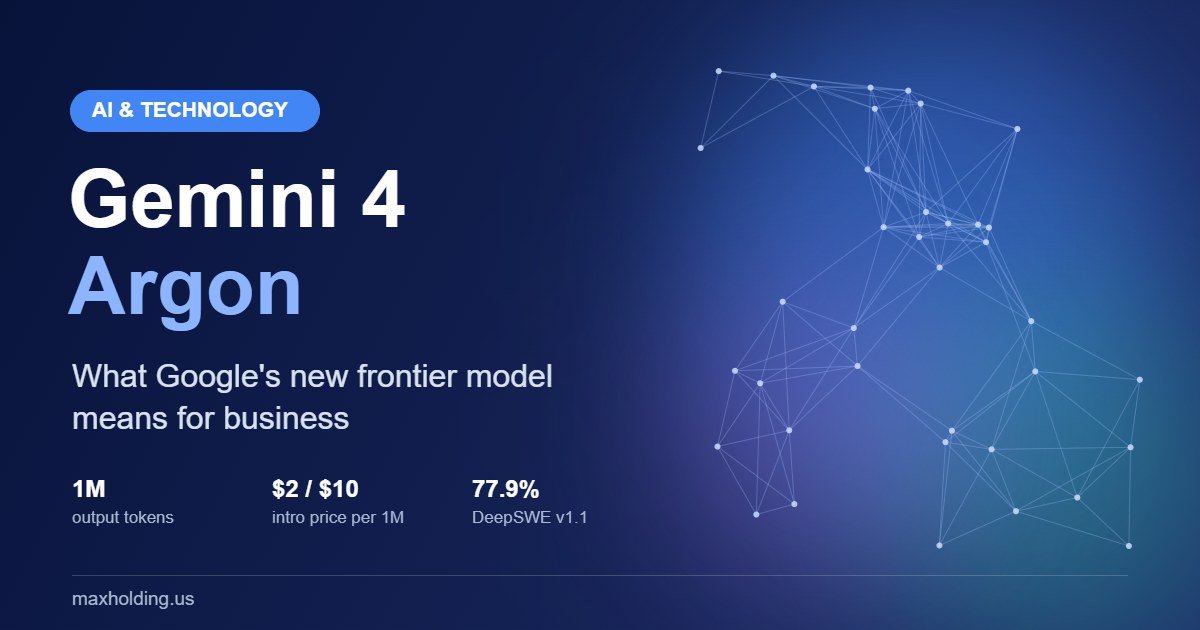
Gemini 4 Argon: What Google’s New Frontier AI Model Means for Business
Published Saturday Oct 3, 2026 | 9:52 am
Google has introduced Gemini 4 Argon, the first model in its Gemini 4 family and what the company calls its most advanced AI model to date. Announced on September 30, 2026, the model is built for three demanding areas: real-world software engineering, enterprise knowledge work such as legal and finance, and cybersecurity defense.
For businesses in Pakistan and the GCC that are moving more of their operations onto digital systems, the release shows where enterprise AI is heading next: longer, more autonomous workflows that go beyond simple chat.
Quick Facts
- Announced: September 30, 2026, by Google.
- Focus areas: software engineering, enterprise knowledge work, and cybersecurity defense.
- Output limit: up to 1 million output tokens, up from 64,000 in earlier Gemini models.
- Introductory API pricing: $2 per million input tokens and $10 per million output tokens.
- Standard API pricing: $4 per million input tokens and $20 per million output tokens, with cached input priced 95% below the standard input rate.
- Initial access: trusted cyber defenders through Google’s Fairwind Program, followed by paid API customers and Google AI Ultra subscribers.
Key Capabilities
Software Engineering
Google positions Argon as a model for real engineering work, including debugging, long-horizon coding tasks and codebase migrations. According to Google’s announcement, the model scored 77.9% on the DeepSWE v1.1 software engineering benchmark.
Cybersecurity Defense
One of Argon’s main selling points is security. Google says the model can help find, validate and patch software vulnerabilities, and reports a 68% score on CWE-bench v1 for vulnerability remediation, tied for first place. This focus explains why the first rollout went to cyber defenders in the Fairwind Program.
Enterprise Knowledge Work and Automation
Google reports that Argon ranked first on Zapier’s AutomationBench with 51.3% and led the Vals Index, which tests models on professional tasks in areas such as legal and finance. Vals AI listed the model first of 41 models with a score of 68.9%.
Long Video and Visual Understanding
The model also handles complex visual inputs, including charts and long videos. Google cites a 91.7% score on LVBench, a long-video understanding benchmark.
How Argon Compares to Rival Models
Google states that Argon outperforms several rival frontier models on its selected benchmarks. Independent testing gives a more mixed picture. Artificial Analysis describes the release as putting Google back among the top three AI labs, while third-party comparisons show competing models still ahead on some agentic coding tests, including Terminal-Bench.
For business buyers, the practical takeaway is that no single model leads on every task. Choosing a model should depend on the workload, cost and testing done on your own data.
Safety and Security Measures
Because Argon is designed to take autonomous actions, Google has highlighted several safeguards:
- Red-team testing of safeguards against misuse.
- Leading performance, according to Google, on Gray Swan’s Indirect Prompt Injection benchmark.
- Monitoring of the model’s reasoning and actions to detect misaligned behavior.
- Hardened sandbox environments for running agent tasks.
Even with these measures, companies deploying AI agents should keep their own access controls, logging and human review in place, especially for systems that touch customer data or financial records.
Why Gemini 4 Argon Matters for Business
Models like this are changing what companies can realistically automate. Several areas stand out for diversified groups operating across Pakistan and the GCC:
- IT and software teams can use AI agents for code reviews, legacy system migration and faster bug fixing.
- Security operations can speed up vulnerability detection and patching across websites, ERPs and internal tools.
- Document-heavy functions such as contracts, compliance, procurement and finance can draft, review and summarize large volumes of material.
- Operations and reporting benefit from a 1 million token output limit, which allows very long reports, datasets or code to be produced in a single response.
Pricing also matters. At an introductory $2 per million input tokens, and with heavy discounts on cached input, running large internal workflows is becoming more affordable for mid-sized companies, not just global enterprises.
Industry Context
The launch comes amid fast competition among AI labs and a broader shift toward AI agents that complete multi-step tasks on their own. Google’s Gemini app passed one billion monthly users in August 2026, according to TechCrunch, giving Google a large base to bring Argon’s capabilities to consumers and businesses.
At Max Holding, we follow these developments closely because AI and automation now shape how businesses across energy, logistics, hospitality, healthcare and staffing operate and compete.
What Comes Next
Google plans to widen access beyond the Fairwind Program, starting with paid API customers and Google AI Ultra subscribers, before a broader rollout to developers, enterprises and consumers. Interested businesses can use this window to identify pilot use cases, review data policies and set clear success measures before access opens. Teams exploring AI and automation for their operations can get in touch with Max Holding.
Frequently Asked Questions
What is Gemini 4 Argon?
It is Google’s newest frontier AI model and the first in the Gemini 4 family, announced on September 30, 2026, and focuses on software engineering, enterprise knowledge work and cybersecurity.
Is it called Gemini Argon 4 or Gemini 4 Argon?
The official name is Gemini 4 Argon. “Gemini 4” is the model generation and “Argon” is the name of this specific model.
How much does it cost?
Introductory API pricing is $2 per million input tokens and $10 per million output tokens. Standard pricing is $4 per million input tokens and $20 per million output tokens, with cached input tokens discounted by 95%.
Who can use it right now?
Access is first going to trusted cyber defenders through Google’s Fairwind Program. Paid API customers and Google AI Ultra subscribers are next in line, followed by a wider rollout.
What is its output token limit?
Argon can generate up to 1 million output tokens, a large increase from the 64,000-token limit of earlier Gemini models.
How can businesses prepare?
Companies can start by listing repetitive, document-heavy or code-heavy tasks, setting data security rules, and planning small pilot projects so they are ready to test the model once broader access becomes available.